Article
You’ve had a good few months, you’re moving better, training again, maybe even starting to trust your back again, and then one morning you put your socks on and it goes.
The pain is awful, and the thought comes straight away: “I’ve done it again. It’s the disc. Everything I’ve built is gone.”
I’ve spoken to 177 people with back pain on calls this year, and the fear that comes up most, more than the pain itself, is some version of “I’m going to be stuck like this for the rest of my life.”
I know that thought well. In 2018 a doctor had looked at my L5-S1 bulge and told me never to squat again, so after my second bad flare up every twinge got run through the same filter: is this the disc, is it getting worse, have I just done something I can’t undo? Getting that wrong cost me four years of my life.
The flare up isn’t the mistake. The belief about what it means is.
(One thing first. If you’ve got worsening numbness or weakness, bladder or bowel changes, or numbness around your groin, get seen by a doctor that day. For almost everyone else, read on.)
Pain is real, but it isn’t a damage meter
Your pain is real, and nobody’s telling you it’s in your head, but the amount of pain you feel doesn’t reliably tell you how much is going on underneath.
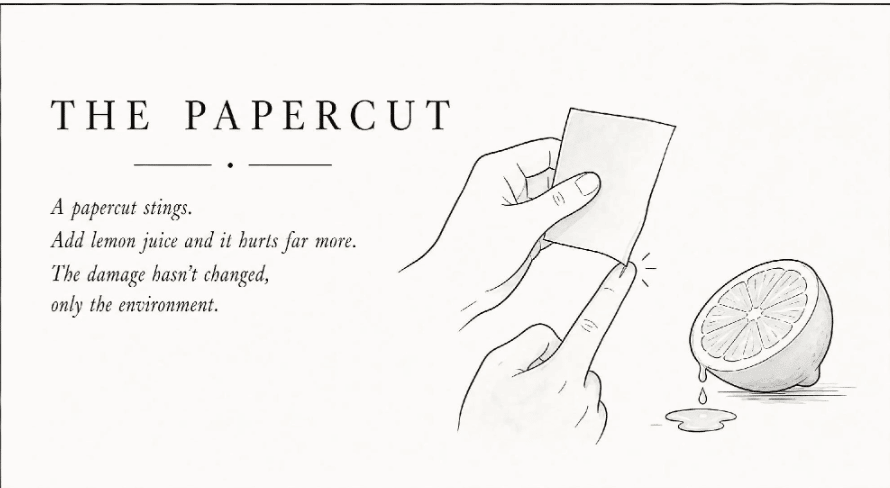
Physiotherapist Ben Cormack has the simplest example I know. A paper cut stings like mad while barely marking you, and if you squeeze lemon juice on that same cut it hurts far more, even though nothing about the cut has changed, only the conditions around it. It works the other way too: think of the last bruise you found on your leg with no idea how it got there, real tissue damage and no memorable pain at all.
So if nothing tore, why did it flare?
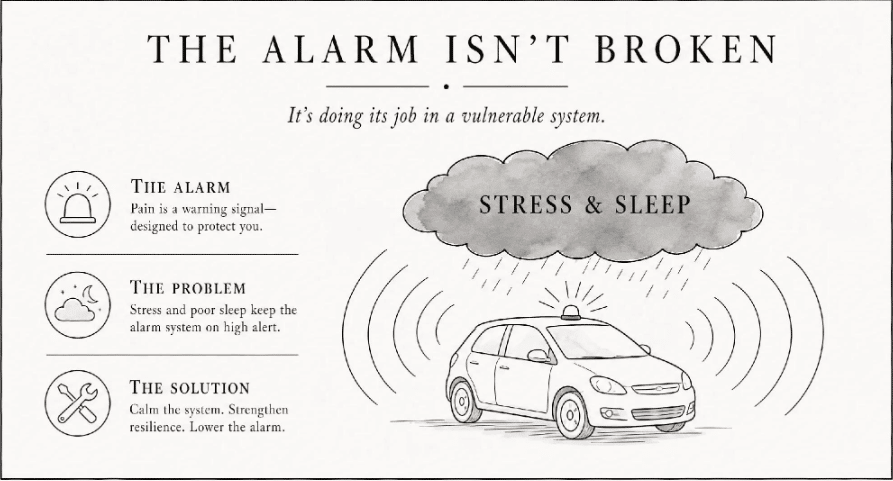
The dam has been filling for a while Poor sleep, a stressful few weeks at work, hours at a screen and very little movement put your nervous system on high alert, primed to protect you a bit harder than the situation calls for. It isn’t broken, it’s doing its job under worse conditions than normal.
That’s why a flare so often shows up the week you slept badly, the week a deadline landed, or the week you stopped training, and why “I just bent down to pick up a sock and it went” nearly always has a lead-up. The sock is the drop of water that breaks the dam, but the dam has been filling for a while.
So the most useful first question usually isn’t “what have I torn?” but “what has my week actually looked like?”
One of my clients, we’ll call him John, herniated a disc deadlifting in his early twenties and was stuck in constant flare ups for over 10 years. He’d been training consistently for over three months, and in his own words he was “feeling really good and completely pain-free, basically.”
Then, doing a bird dog two days after a session had left his back twinging, he felt his lower back give and couldn’t stand up. For three or four days he was crawling up to bed, and it was so bad his girlfriend called an ambulance.
The doctor told him it was probably another disc herniation, and mentioned he might need surgery again. Those words did more damage than the flare itself, because they confirmed exactly what his brain was already thinking: everything he’d built was gone and he was back to square one.
That’s nocebo, where we believe the worst outcome will happen, in particular when a doctor or physio has said it to us.
His last MRI showed a bulge at L4-L5, and every fear from those old diagnoses came flooding back, even though the scan was exactly the same as it had been before the flare. Disc bulges and degeneration show up constantly in people who have no pain at all, and a lot of what’s on a report is closer to what physio Peter O’Sullivan calls wrinkles on the inside, the normal changes that come with being an adult who has lived in their body.

When our own physiotherapist assessed John, the picture was very different. There was some nerve sensitivity, but nothing pointing to a herniation, it was a flare up that had made the nerve a bit sensitive. His back had been twinging for two days before that bird dog, so the bird dog wasn’t the cause, it was the last drop. He’d done the right things, slow walking and gentle movement, the flare was settling, and he wasn’t back at square one.
How to Break This Cycle
Here’s the pattern I see most with clients. They get a flare up, they rest, it calms down, they do a bit of physio, and then, in one person’s words, “I quit the physiotherapy once I was feeling okay.” Rest calms a flare up, but it doesn’t build your capacity, and most people stop the day they feel okay, which is exactly why the next flare up happens.
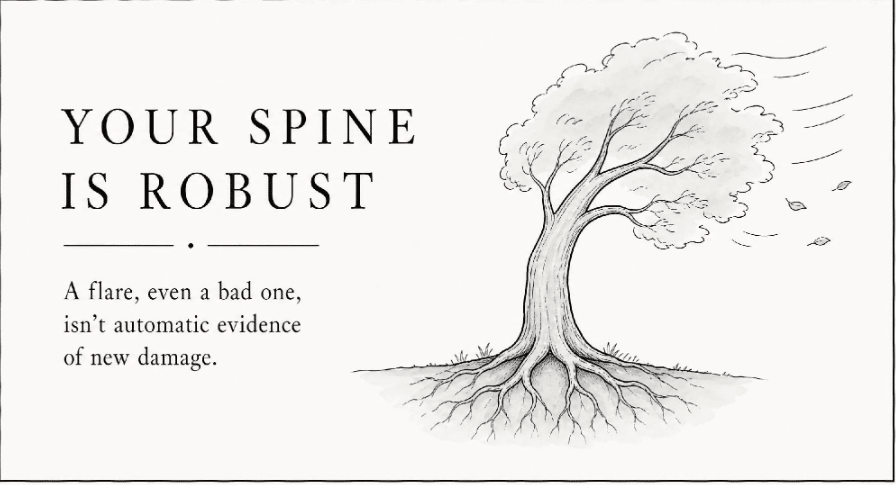
Another client, Sami, had one exercise he knew would strengthen his back, the hinge, and it flared him up every time he tried it. So instead of avoiding it, we built him up to it slowly, and even when he had a flare along the way, it didn’t send him back to the start.
By our last call he was hinging with “no pain, no nothing,” travelling from New York to Cyprus and Vegas without a problem, and playing tennis every other day. Nothing about his spine needed to change, what changed was how much he could handle and how he responded to the sensations along the way.
Conor
P.S. Have you had a flare up you were sure was the disc? Hit reply and tell me what happened.
Originally published on Substack.
Get new posts by email.
Published on Substack. No spam, unsubscribe any time.