Article
Back in my mid-twenties, I was always chasing PRs.
Heavy squats, triathlons, 10Ks. If it had a number attached to it, I was after it.
I was in the gym six days a week. And from the outside, life looked good. I was young, fit, coaching clients for a living, and hitting the kind of numbers that got a nod at the gym.
But then my back went.
L5-S1 disc bulge. I could barely put my socks on in the morning. The doctor told me to stop squatting and stop deadlifting.
What followed was four years of fear. Fear about my career. Fear the back would never come right again. Fear about who I’d be physically at 40, 50, 60.
Looking back now, I understand something I couldn’t see at the time. I’d never built a proper foundation. I’d been chasing a ceiling of numbers without ever laying the floor.
A call I had this week
I got on a call this week with a business owner in his mid-30s. He’d put his back out twice in the last three years. The most recent one was three months ago.
Here’s the timing.
His wife had just given birth to their second child. Newborn and a toddler in the house. This back injury laid him up for three weeks. He couldn’t work. He couldn’t help his wife with the kids. He was just stuck on the sofa waiting for it to settle.
Eventually it did. He got back to work. Life kept moving.
But on the call, it was clear he knew this wasn’t random. This was a signal. Something was wrong, and he kept flaring it up. Between the financial hit of not being able to run his business for three weeks, and the emotional strain on the household of not being able to help with the kids, the cost of this last flare-up had already been huge.
He decided not to move forward. Part of it was financial constraints. Part of it was that his back was no longer in pain, so he figured he’d probably be okay. He’d try to figure it out himself. Learn his lesson this time. Be a bit smarter in the gym.
I get it. I’m not going to talk anyone into working with me who doesn’t want to work with me.
But it’s interesting. I talk to hundreds, sometimes thousands of people every year about this stuff, and I hear both sides of this fence constantly. The people who eventually sign up have almost always ignored a signal like the one this guy is ignoring now. Then it gets worse. Then it happens again. Then they finally take action.
Preventative work is a much harder sell than acute pain. The pain isn’t high enough yet to force the decision. That’s just human nature.
But here’s what I know from doing this for over 15 years.
The guys who “figure it out themselves” after a warning signal like that almost never do. It’s not a discipline problem. This guy has plenty of discipline. He runs a business, he trains, he shows up. He can execute anything you put in front of him.
It’s a map problem.
He’ll spend the next 12 months second-guessing every session. Is this movement safe? Is this too heavy? Am I doing enough? Am I doing too much? Is this ache normal or is it the start of another flare-up?
That’s a lot of mental bandwidth to be spending on your back. Bandwidth that should be going into his business, and more importantly, his family.
And unfortunately, the back will probably go again. Hopefully when it does, he’ll see the full cost of it clearly enough to make a different call the next time.
What Craig did last week
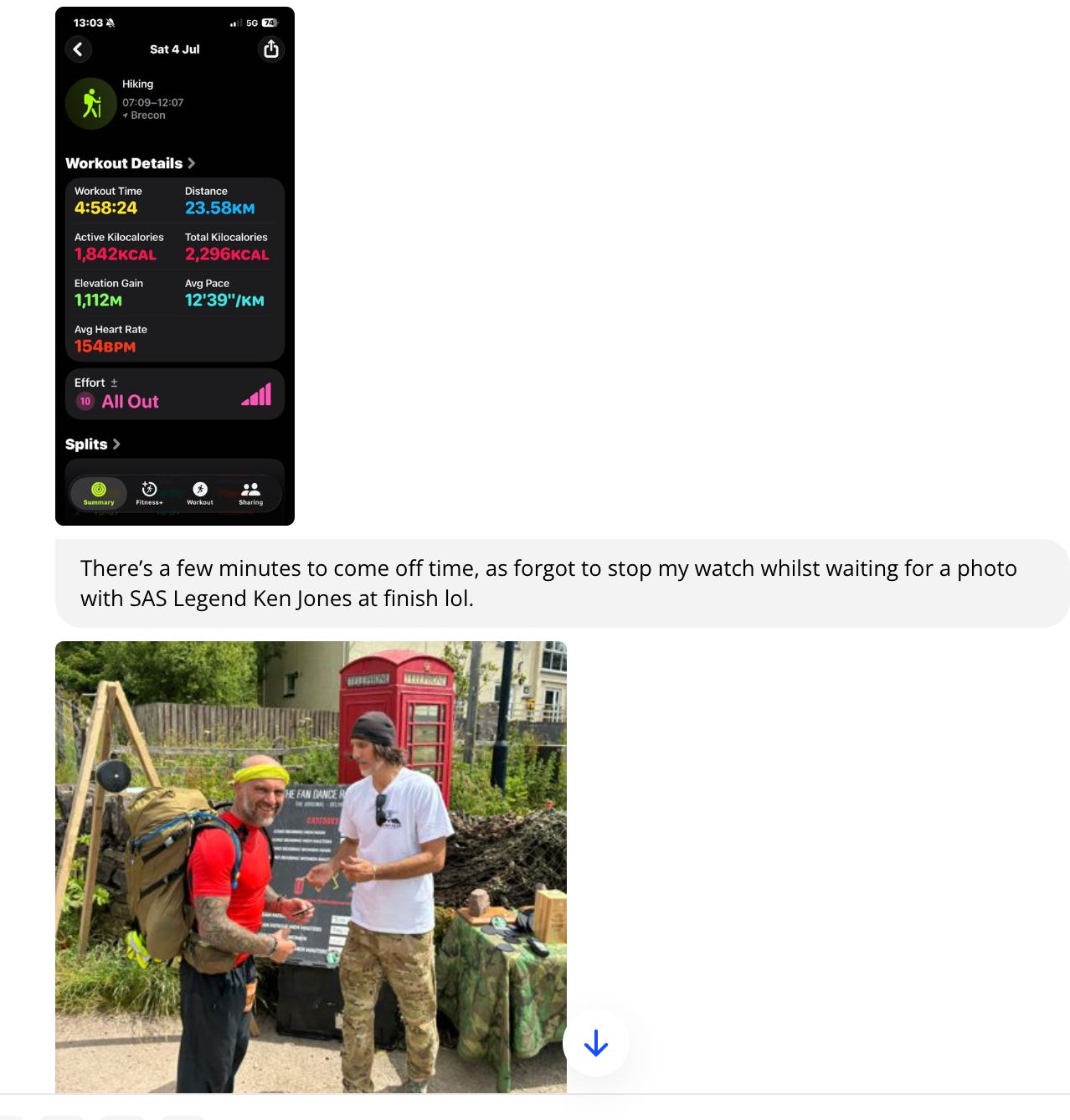
Now compare that to another client of mine, Craig.
Craig is 55. Ex-paratrooper. We started working together last year, after four and a half years of chronic back pain that had him afraid to pick up his grandson.
Last week, Craig completed the Fan Dance.
If you’re not familiar with it, the Fan Dance is a 24km loaded march used as part of SAS selection. It goes up and over Pen y Fan, the highest peak in South Wales, and back again. Timed, weighted pack, straight up and straight back down. It’s one of the most well-known military selection tests in the world, and it breaks most people who attempt it.
Craig did it at 55. After four and a half years of chronic back pain.
The difference isn’t that Craig is some outlier or has some superhuman recovery. He’s not, and he doesn’t.
The difference is that when he came to me, he was willing to do the boring stuff first. He didn’t chase output. He rebuilt the base. Restored movement patterns that had been broken for years. Learned to load his back in ways that made it stronger, not ways that just tested how much it could take before it snapped.
Only then did we build performance on top of the foundation.
If Craig had walked into a gym at the start of this and asked for a program to prep him for the Fan Dance, and someone had given it to him, he’d have flared up inside three weeks. Instead, he now has a body that can do that event and recover from it. Not just survive it.
There’s a symmetry with these two situations, back to back in the same week.
The business owner is in his mid-30s. He has the warning signal right in front of him. He has the choice, right now, to build the floor before the whole thing collapses again.
Craig ignored his warning signals for years. He tried to figure it out on his own. He went through four and a half years of chronic pain that affected every corner of his life, especially not being able to pick up his grandson, before he finally decided he needed a proper path.
The floor is boring
Here’s the thing about building a foundation. Nobody sees it.
Nobody claps when you spend three months restoring hip mobility. Nobody gives you a fist bump at the gym for holding a proper hollow body position.
The floor is boring. It doesn’t photograph well. It doesn’t get likes or shares online. And it can genuinely feel like you’re wasting your time doing the boring stuff.
But the guys I see still training well into their forties, fifties and sixties are the ones who built the proper foundation first. Their performance might come slower. But when they achieve things, they can actually sustain them. And when life throws something unexpected at them, a bad week of sleep, a stressful stretch at work, a newborn at home, their back doesn’t go out on them.
Because the floor is there.
The ceiling guys, by contrast, are the ones I meet after the wheels have come off. They’ve chased output for a decade and now their body has finally said no.
So here’s my question for you this week.
Have you built a proper foundation?
Or are you one awkward movement away from another flare-up?
Conor
Originally published on Substack.
Get new posts by email.
Published on Substack. No spam, unsubscribe any time.