Article
When most people think about back pain, they think about a sore back. The ache when you get out of bed, the stiffness after a long drive, the twinge when you bend down for something.
But that’s only the part you can feel. What nobody warns you about is everything else it takes from you: the confidence to train the way you used to, the plans you cancel because you’re not sure your back will hold up, the low mood that creeps in when you start to wonder whether this is just your new normal. And the cost that hits hardest for a lot of the people I work with is the one on their family, because they can’t look after their kids the way they want to.
We had a new client come to us about four weeks ago. She’s fit, she loves running 10KM in the morning, but for the last 11 months her back has been so bad that she couldn’t pick up her infant daughter without pain. The injury happened just after her daughter was born, so for almost her daughter’s whole life, picking her up has come with pain. On her first call she told me that fitness was her stress release, that she was scared to go for a run in case her back flared, and that she’d started to wonder if this was just how life was going to be now.
Today she posted this in our
group:
“I managed to pick up my daughter today for the first time ever pain free in 11 months.”
This was a huge win because previously she was stuck in recurring flareups. Like a lot of clients, when they get a flareup, they respond in one of two ways.
You freeze and avoid everything,
You try to fix it by stretching, massaging and doing more exercise, which stirs everything up even more.
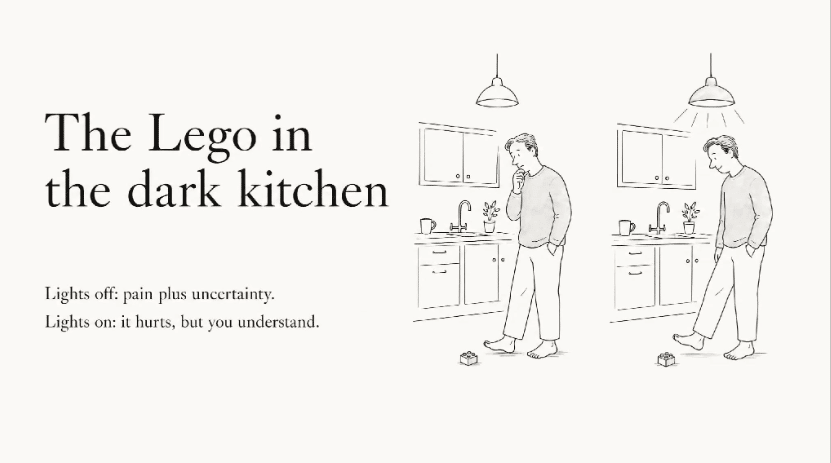
Neither works well, and both come from the same place: the flare-up feels far more dangerous than it is. Think about stepping on something sharp in your kitchen in the dark. You don’t know what it is, so you panic and wonder if it’s a nail.
Now picture the same thing with the lights on, and you can see it’s a piece of your kid’s LEGO. It hurts just as much, but you know it’ll settle in a few hours, so you don’t spiral. Most flare-ups are LEGO in the dark. They’re painful and distressing, but they’re not damage, and the more you can see them for what they are, the faster your system settles.
So here’s what I take our clients through when a flare-up hits:
Remind yourself you haven’t lost your progress. The first thought is always “I’m back to square one”, and it isn’t true. One of our clients, Tre, had 10 years of back pain, then 3 months into the program he had his biggest flare-up in five years and ended up on a crutch. What he said afterwards was that it didn’t bother him, because he knew exactly what the next steps were and he’s no thriving at month 5.
Check for red flags. If you have problems with your bladder or bowels, numbness around the groin, your foot starts dragging, or you have severe pain at night, see a doctor first. Anything else is painful but not serious.
Cut your training down, don’t stop it. We strip the program back to the one or two movements you can do comfortably for a few days, then build it back up from there. You want to remind your back that movement is safe without overdoing it.
Settle the system. Find positions that feel good, like lying with your feet up on a chair or a couch while you breathe slowly into your belly, or lying on your stomach. Go for short walks to get blood moving. Use ice if the pain is sharp and irritated, and heat if your back feels stiff and tight.
Happy Friday,
Conor
P.S. how do you handle flareups? Hit reply and let me know!
Originally published on Substack.
Get new posts by email.
Published on Substack. No spam, unsubscribe any time.