Article
One of the most common patterns I'm seeing right now with the guys who come to work with me isn't a discipline problem. It's a knowledge problem.
Most of them played sports growing up. Then a combination of things piled on, sedentary work, young kids, poor sleep, training hard without any real structure behind it. They started pushing past their own capacity without ever realizing it, because none of it looked like an injury while it was happening.
Then out of nowhere, their back goes. And it's rarely something dramatic. Picking their kid up off the floor. Bending down to put a sock on. Something so insignificant it barely registers as a real reason. When you're in your thirties or forties and part of your identity is being the guy who used to play sport, used to be strong, that's a hard thing to accept.
Here's the pattern most of them fall into after that. In the early flare ups, resting actually helped. So that became normal.
Back off, wait it out, go back to normal. For a while that worked, or at least looked like it worked. They'd get away with it for a few months, sometimes a few years. But the pain kept coming back, and each time it came back a little worse, until it stopped being something they could just wait out.
And it gets more confusing from there, because of what they're finding online. One person telling them to never flex their spine again. Another saying: rest and gentle movement is the answer. A third saying the opposite, lift heavy, deadlift, push yourself, it's a weakness problem. Nobody agrees, so what you're left with isn't clarity, it's program hopping. Chasing whatever looks like the answer this week, never actually getting anywhere with any of it.
That's usually the point someone reaches out to me, wanting the actual root cause fixed instead of managed around.
This article is about fixing that specific problem. Not another program to hop to, but how to actually think about training progression, so you know how to push and how to pull back depending on how you're feeling on any given day.
The program: 2 sessions, 3 days a week
Session A is squat dominant. Session B is hinge dominant.
You alternate them across the week: Monday A, Wednesday B, Friday A.
The next week you flip the order and start with B. Over a fortnight, both sessions get trained three times each. Nothing gets neglected, nothing gets stale.
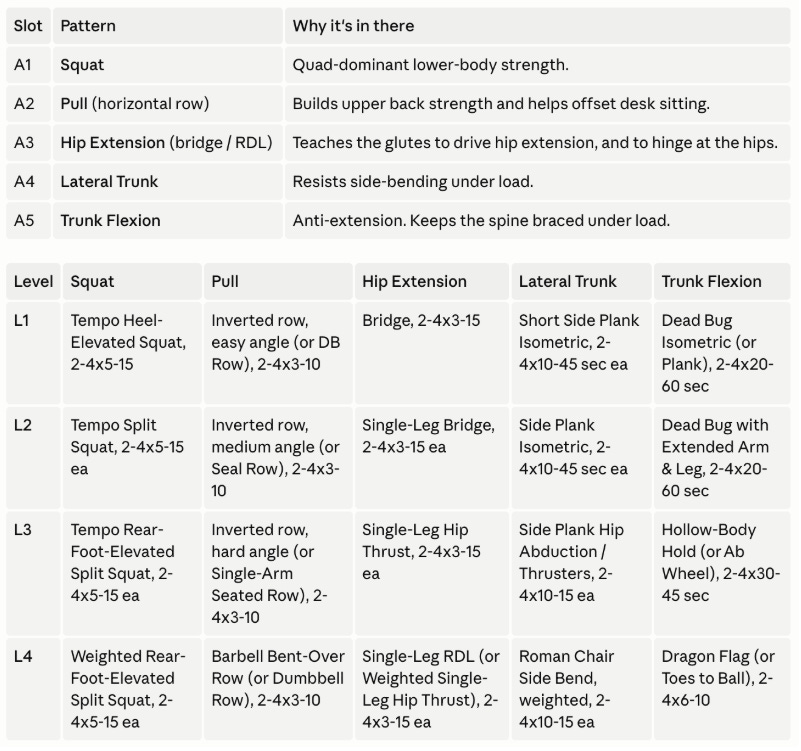
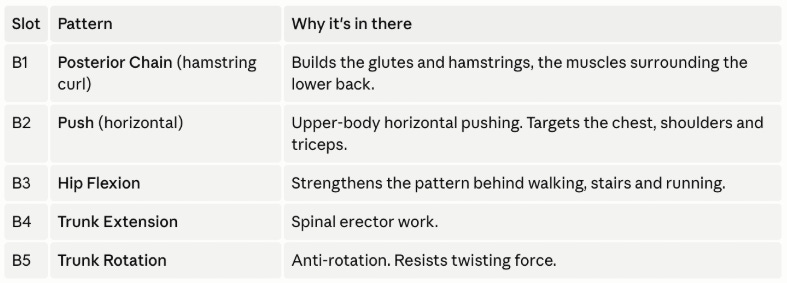
Each session pairs its dominant lower body pattern with an upper body pattern that balances it, plus two core slots.
Squat pairs with pull.
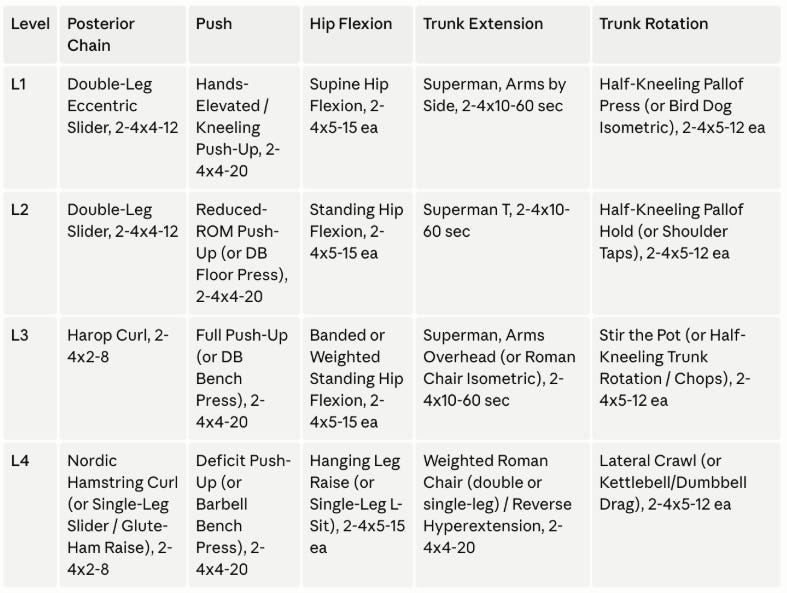
Hinge pairs with push.
I like programming it this way because it lets us train the whole body without overloading any single area. That matters even more when someone's back is sensitised. Spreading volume across patterns rather than body parts means less tissue irritation on any given day, and fewer flare ups between sessions.
Session A: Squat dominant
Session B: Hinge dominant
How to find your level, and how to climb it
Start at roughly 50% of what you think you can currently do. Your sense of what counts as “easy” is anchored to who you were before the injury, not who you are right now. Something can feel genuinely easy in your head, because you’re comparing it to your old capacity, while it’s still well past what your tissue or your nervous system can currently tolerate. That gap between how easy something feels and what it’s actually asking of your body is exactly where most flare ups come from.
Pick the version of each pattern you can do for the full set and rep target without pain going above a 3 out of 10, and without it flaring the next day. That’s your starting level.
If you’re not sure, just start everything at level 1. Get comfortable there for a few weeks, then progress. It’s a far better mistake to make than starting too high.
So we deliberately start too easy. This builds consistency and confidence. Let the movement feel completely safe again. Then we load it, slowly, once that base is actually there. I’d much rather go slower with someone at the start, because what that buys you is a large number of consistent, clean reps, and that matters more long term than how quickly you get back to all movements.
The longer you train consistently the bigger your capacity becomes, not just in low back rehab, but all training.
Train below your capacity on purpose, and you get further, faster, than someone sprinting back to their old numbers and getting knocked back to zero every few months.
Progress the level once a movement feels genuinely easy across multiple sessions.
Why I use movement patterns and not exercises
They build tissue tolerance. Your discs, your tendons, your muscles, they adapt to the load you actually give them, gradually, over weeks and months. A lot of people do low level rehab and then jump back to running and deadlifts and get a flare up. It’s because they’ve pushed past their tolerance to fast.
They build confidence. Confidence in your back is earned, one level at a time, by doing something that used to feel risky and having it go fine. Every level you clear on the ladder is proof your capacity is improving.
They reduce sensitivity. As your capacity goes up, meaning the actual load you can handle without a problem, the sensitivity in your back tends to come down. A back that can hinge, load and rotate without incident stops treating normal daily movement as a threat.
They give you something to see. Six weeks in, “less pain” is a fuzzy, hard to trust measure on a bad day. I like to have clients focus on functionality and what they can do rather that just being “pain-free”.
They let you regress just as easily as you progress. A ladder or level isn’t just a way to progress, it’s also a map for stepping back down when you need to. If you’re mid flare, you don’t have to stop training completely. You drop to the level below where it’s affecting you and keep blood flow and stimulus going into the tissue while things settle. That’s a completely different experience to the standard advice of just resting until it goes away, and it’s the reason someone on this system rarely has to take a full week off training entirely.
Why this helps with fear of movement
A lot of people carry fear around one specific movement. “Deadlifts hurt my back.” “Squats hurt my back.” In practice that often means deconstructing the exact movement someone’s afraid of down into its easiest, most manageable piece, often without them even realizing that’s what’s happening. Deconstruct the deadlift down to a dowel hinge. Deconstruct the squat down to a box squat to a high box. Most of the confidence gets rebuilt before they’ve clocked that they’re training a version of the thing they were scared of. By the time they’re ready to load the real movement again, the capacity’s already there and most of the fear’s already gone with it.
This isn’t just for back pain, either. It’s the same reason I’d use it with someone chasing their first handstand or trying to add weight to a squat with no injury history at all. Instead of “still can’t do it,” they’re working through a whole set of variations and clearly improving. That’s a much easier thing to stay motivated by than staring at the one thing you can’t do yet.
Pain doesn’t equal harm
Sometimes when you progress your training, you’ll get a sensation, something that feels a bit like a flare up. A lot of the time, this is just adaptation, and it helps to reframe it. Not as damage, but as something more like sunburn or a cooker burn.
You don’t panic when that happens. You just accept a little discomfort for a few days. That’s a great way to think about your back when it flares up too and in my experience, your response to pain is as important as the actual pain.
Most of my back issues stemmed from anxiety about what this meant when I got a flareup. “Will I be in pain forever?”, “Will I need to change careers?” “What will this be like when I’m 50, if this is a problem at 28?”.
The catastrophisation was worse than any pain I experienced physically and having someone reframe this for me would have helped a lot back then.
Why we focus on more than your back
I don’t like to isolate one area of the body, because everything is connected, and the sooner you return to doing as much activity as possible, the better it is for your back. The less you overfocus on your back specifically, the better too, from an anxiety standpoint.
It still baffles me how much physio and rehab just trains the site. The disc, the joint, the one spot that hurts, in isolation. We’re looking at everything globally instead, because that’s how your body actually works.
Strip the back specific framing off this and what you’re left with is just a genuinely good model for how to progress anyone through progressive overload safely. That works whether the goal is a pain free back or a bigger deadlift.
Graded exposure, which is what this whole article has been about, is one part of the low back puzzle.
Your beliefs about your pain, your stress levels, autoimmune issues, your general health, your sleep, all of that can affect your back too. And for a lot of people struggling with this, those areas need addressing as well, not just the training side.
That’s exactly why I’m going deeper into all of the areas that actually help resolve low back pain, based on what’s working with my clients and the research I’ve been doing. This is just the start of that.
I hope you found this helpful.
- Conor
Originally published on Substack.
Get new posts by email.
Published on Substack. No spam, unsubscribe any time.