Article
If you’ve ever bent down to pick up a laundry basket and ended up on the floor, you know the confusion that follows. You’ve lifted that basket a hundred times and nothing about it was different, so why did it flare up your back this time?
Most people go looking for the one thing that caused it, whether that’s the twist, the lift, the bad mattress or the deadlift session three days earlier. In my experience that search rarely ends anywhere useful, because it’s built on the wrong question. Your back doesn’t respond to one input, it responds to a whole system of them.
The cup analogy
Let me give you an example. You can run the exact same training week twice, same exercises, same sets and reps, and feel great one week and get a flare-up the next. If the program was identical, the program can’t be the explanation.
The clearest way I’ve found to think about this comes from physiotherapist Greg Lehman, who uses a cup as an analogy. Everything that stresses your system pours into it: your training, a short night’s sleep, a hard week at work, a few days of eating whatever’s convenient, and even the story you’ve been told about what’s wrong with your back.
Pain doesn’t usually turn up because of a single thing. It turns up when your cup overflows. That’s why the same laundry basket can do nothing on a Tuesday and put you on the floor on a Friday. The weight of the basket didn’t change, but the level in your cup did.
So when we rehab someone’s lower back, we focus on draining the cup so it stops overflowing, and then we build a bigger, more robust cup so you can do more with your life without getting these frustrating flare-ups.
My own cup in 2018
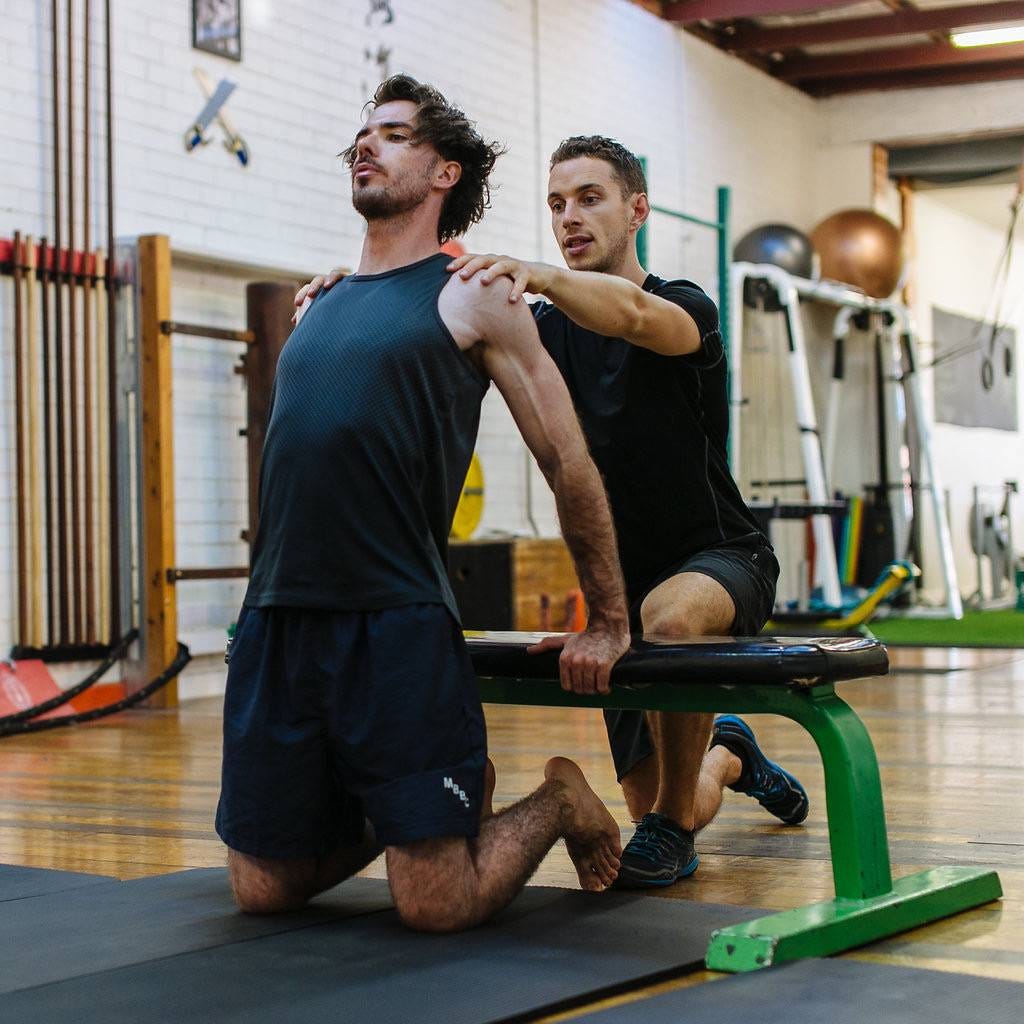
When I look back at my own low back history, it was at its worst in 2018, when I was living in Melbourne. I was trying to get my business off the ground in one of the most competitive cities in the world for a personal trainer, and I’d moved there from Asia, so the cost of living was a huge shock. So was the size of the place. Melbourne has about as many people as the whole of Ireland, and I’m from a village.
I was also battling a parasite infection (Blastocystis hominis) from my two years living in Asia. I was training heavily, putting on 10 kilos of mostly muscle after two years of doing largely yoga and meditation. And I was averaging about five hours of sleep a night, because I was getting up at 4:30 every morning to be ready for 6am clients.
At the time I thought my back was the problem. Looking back, my cup was full to the brim before I ever picked anything up.
What actually fills it
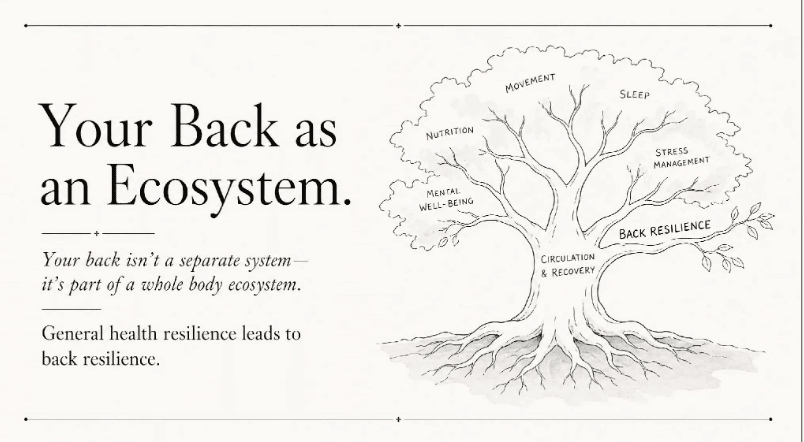
Think about a run of weeks where you slept badly, ate on the go and travelled a lot. If you caught a cold at the end of it, you wouldn’t be surprised. But when your back flares up after the same stretch, almost nobody connects the two, even though your back sits inside the same run-down body. Here are some examples.
Sleep. Sleeping five hours or less is associated with more low back pain (Chun et al., 2018), and a review of 16 studies following around 61,000 people found that worsening sleep raised the risk of developing pain later (Afolalu et al., 2018). It runs both ways: bad sleep feeds pain, and pain wrecks sleep.
Stress. Repeated or prolonged stress changes the systems that regulate pain and can leave you more sensitive (Jennings et al., 2014), so a brutal month at work is pouring into your cup whether you notice it or not.
Nutrition and general health. A diet that drives up inflammation can leave your system more sensitive to pain. In older adults with back pain, those with more other health conditions had more pain and more trouble functioning a year later (Fu et al., 2023). Your back isn’t a separate system from the rest of you.
This is also why an MRI scan will rarely give you a clear answer. For the large majority of people with low back pain, we can’t pinpoint the exact tissue that’s producing it (Hartvigsen et al., 2018, The Lancet). That sounds like bad news, but it isn’t, because it means there’s more than one way of rehabbing it. If training alone hasn’t fixed it, sleep, stress and nutrition are three more doors sitting right next to it.
What you believe about your back
There’s one more input that’s easy to miss, and it can shrink the cup without you noticing: the story you tell yourself about your back.
If you believe your back is fragile, that the next wrong move could put you out for a week, your body acts on that belief. Physiotherapist Ben Cormack puts it as “your psychology drives your physiology,” and he’s right.
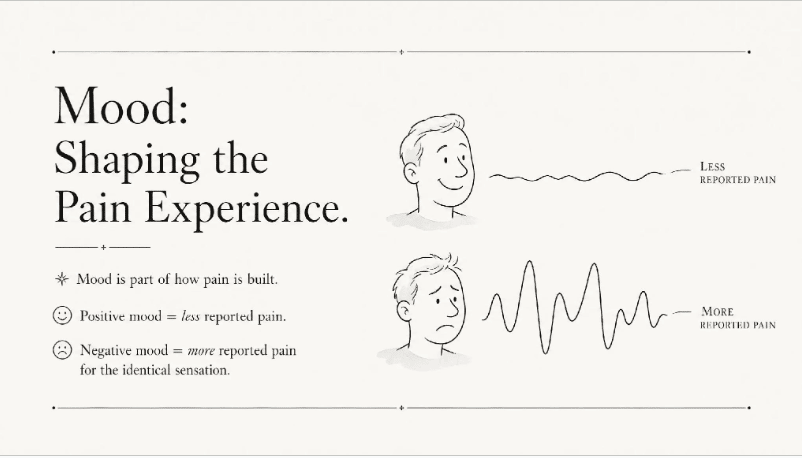
Mood plays into it too. On a low or anxious day the same physical sensation gets rated as more painful , so your back isn’t lying to you when it feels worse on a bad day. And if you’ve felt low or anxious since this started, that’s completely normal. Your pain is real, your mind is part of how that pain gets perceived, and both of those things are true at once.
But here’s where a lot of people get stuck with years of chronic back pain. Fear makes you guard your back, guarding becomes avoiding things, avoiding leaves you weaker and less capable, and feeling weaker confirms the fear, so you protect your back even more. Researchers call this the fear-avoidance cycle (Vlaeyen and Linton, 2000), and every lap of it shrinks your cup until something as small as a laundry basket is enough to tip it over.
The good news is that the loop runs in both directions.
You don’t need certainty to start
The philosopher David Deutsch talks about pursuing error correction rather than certainty, and that captures how I approach back pain. We may not be able to tell you exactly which structure is hurting or why it flared up this week, but we can build a working picture of what’s probably contributing to it.
Maybe your training progressed faster than you could recover.
Maybe you’ve become so careful that you’re doing less every month.
Maybe your sleep, your stress or the way you respond to pain needs some attention.
We don’t assume every factor is a problem. We look at what matters to you, change one thing, watch how you respond and adjust as needed. I won’t pretend that’s easy, because it’s often confusing, but the self-awareness you build doing it keeps you strong for the rest of your life.
Four changes that build a bigger cup
1. Walk every day. Treat it as a habit, not a training session, and break it up across the day if that’s easier. In the WalkBack trial, people recovering from an episode of low back pain who followed a walking program went a median of 208 days before their next episode, compared with 112 days for those who didn’t (Pocovi et al., 2024, The Lancet). It also means less time sitting, which irritates a lot of backs.
2. Improve one thing about your sleep. Make one change and hold it for two weeks before adding another. The simplest framework is the 3-2-1 rule: no meals in the three hours before bed, no fluids in the last two, and no screens in the final hour. In my experience, cutting out technology an hour before bed gives the biggest return on sleep quality.
3. Build a ten-minute transition between work and home. Go for a walk, have a coffee or tea, change your clothes, anything that marks the switch from work mode to home mode and back again. Without it, work stress bleeds into your evenings, and your evenings bleed into tomorrow’s back pain. This was a key change for one of our clients who wasn’t responding to the other changes we’d made.
4. Keep something you enjoy in your week. If you used to go to a run club and loved the community, and that’s not possible right now, set up a time to meet some of those friends for a walk or an easy hike instead. And if you’re very limited at the moment, tie your rehab to the reason you’re doing it. You’re not just doing some boring exercises, you’re doing them to get back to running, or to whatever activity you value.
A quick way to check your cup
Once a week, give yourself a score out of five for sleep, stress, mood and how hard you’ve trained. You’ll start to see your flare-ups line up with the weeks your scores were at their worst, and that’s where you start building the self-awareness to finally get on top of this.
Conor
PS. What resonated most with you from today? Hit reply and let me know.
Originally published on Substack.
Get new posts by email.
Published on Substack. No spam, unsubscribe any time.